Initializing...
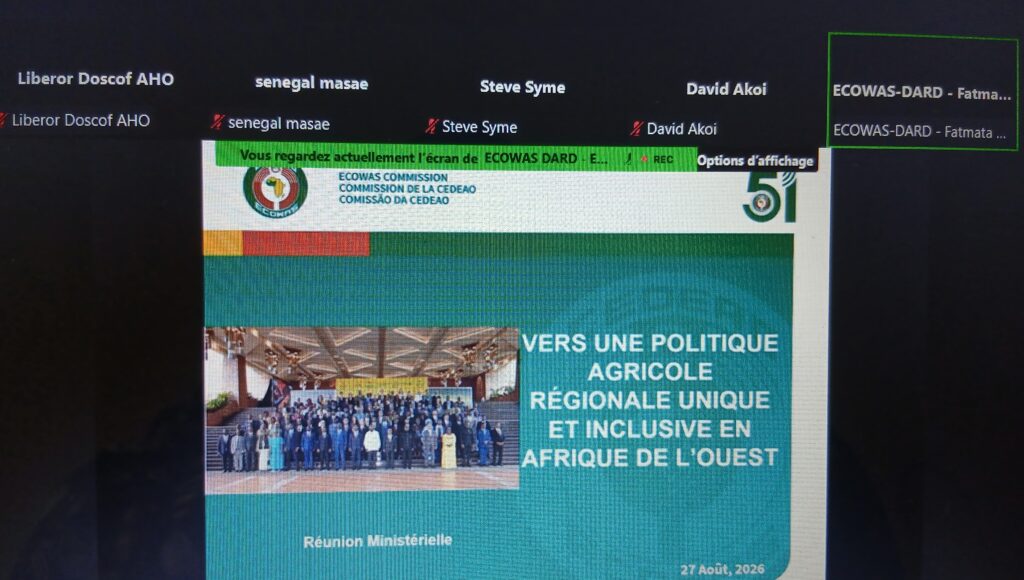
The new ECOWAP, the agricultural policy of the Economic Community of West African States (ECOWAS), must be less of a policy of documents and more of a policy of investments, actions, and results.
This conviction was expressed by the Senegalese Minister of Agriculture, Food Sovereignty, and Livestock, Cheikhou Oumar Ba, on Thursday, August 27, 2026, at the opening of the virtual ministerial meeting dedicated to the ECOWAP review.
For Mr. Ba, whose country currently holds the rotating chair of ECOWAS, the new ECOWAP must not be a mere procedural update of the existing policy. It must be a policy of transformation, food sovereignty, value creation, and job generation, as well as a policy of resilience, regional integration, and stability.
Taking stock of ECOWAP’s twenty (20) years of existence, he noted that it has helped build a solid regional policy and institutional architecture, while contributing to strengthening agricultural planning, developing regional food security instruments, setting up an early warning system, and promoting research and innovation. These achievements will be preserved, he stated, while also pointing out ECOWAP’s limitations.
Among these limitations, he highlighted financing difficulties, weak implementation of commitments, shortcomings in regional trade, low participation of women and youth, demographic growth, rising food demand, underemployment among West African youth, climate change, flooding, poverty, armed conflict, and persistent food insecurity.
“The next decade must enable us to build on the foundations of more sovereign, productive, competitive, resilient, and inclusive food systems. And that is where the ambition of the new-generation ECOWAP must lie,” he declared.
According to him, the new ECOWAP must be accompanied by a true financing pact. Financing for our regional agricultural policy, he suggested, must gradually rely more on the sovereign resources of Member States, while mobilizing the private sector at both national and regional levels, as well as external partners.
Cheikhou Oumar Ba placed special emphasis on the national and regional private sector, which he believes must be viewed as a true partner in agricultural transformation rather than just an
additional sector. For this reason, he suggested involving the private sector in financing and implementing investments under the new generation of ECOWAP.
He advocated for producer organizations, women, and youth to become key actors in implementing the new regional agricultural policy.
According to Mr. Ba, the new ECOWAP must be a policy of results and accountability. “We should no longer wait until the end of a cycle to measure our progress. We must establish a continuous monitoring and evaluation mechanism from the start, tied to biennial reviews that allow us to regularly measure results, identify bottlenecks, and adjust our interventions,” he advised.
He emphasized that the future regional agricultural policy will particularly benefit from the immense assets of the community area, such as the vast West African market, the dynamism of regional integration, the potential of the African Continental Free Trade Area (AfCFTA), the private sector, and innovative alternative financing mechanisms.
“We must use these opportunities as the starting point for a new regional pact to transform our food system,” he specified.
He commended the experts, who had met virtually two days earlier, for the quality of their work and the documents submitted for ministerial consideration, including the draft stocktaking report, the 10-year outlook, and the proposed strategic priorities for adopting the new regional agricultural policy.
For his part, the outgoing Commissioner for Economic Affairs and Agriculture at the ECOWAS Commission, Dr. Kalilou Sylla, expressed his hope that by 2035, ECOWAP will serve as a model of food sovereignty and sustainable economic transformation for West African populations.
As a reminder, ECOWAS’s agricultural policy, better known by its acronym ECOWAP, was adopted in January 2005 in Accra, Ghana, by ECOWAS Heads of State and Government. It serves as the regional strategic framework for agricultural development, food and nutrition security, and the agricultural sector’s contribution to sustainable economic and social development in West Africa.
With the 2015–2025 implementation cycle drawing to a close, ECOWAS launched a new review process aimed at repositioning ECOWAP toward 2035, in line with the renewed ambitions of the Kampala Declaration, the upcoming Comprehensive Africa Agriculture Development Programme (CAADP) 2026–2035 cycle, and the strategic directions of ECOWAS Vision 2050.
The future ECOWAS agricultural policy will be producer-centered and will place an enhanced focus on women and youth—two essential groups for the future of West African agriculture. It will also place special emphasis on agricultural digitalization and the marketing of agricultural products, two recognized levers for modernization and value creation.
Discover how ECOWAS is transforming communities, economies and the lives of West African citizens — one story at a time.