Initializing...
|
VISION The vision of the Directorate of Research and Statistics in the ECOWAS Commission is to build a harmonized, modern, and efficient regional statistical system that serves as an indispensable, data driven compass for public policies, economic transformation, regional integration, and the realization of ECOWAS Vision 2050. MISSION The mission of the Directorate of Research and Statistics in the ECOWAS Commission is to generate, harmonize, and analyze reliable economic, social, and sectoral data to support evidence-based policymaking, regional integration, and the achievement of ECOWAS Vision 2050. CORE AREAS OF FOCUS • Macroeconomic Surveillance and Convergence: |
Section A:
| Department/Directorate | Directorate of Research and Statistics |
| Location | ECOWAS ABUJA, Airport road, Lugbe |
| Commissioner/Director | Samson Bel-Aube NOUGBODOHOUE (Director) |
| E-mail
(Commissioner/Director) |
snougbodohoue@ecowas.int |
| Focal point name | Gbenga ERIN |
| Focal point Email | gerin@ecowas.int |
|
o Operationalizes common regional frameworks for macroeconomic statistics. o Supports the implementation of the ECOWAS Pact on Macroeconomic Convergence and Stability. o Manages and updates key regional economic databases including ECOMAC and ECOBASE. • Statistical Harmonization and Data Management: o Coordinates the ECOWAS Regional Statistical System (RSS) and works with National Institutes of Statistics (NIS) across member states. o Harmonizes core economic and social statistics (such as national accounts, price statistics, social and demographic statistics, agriculture, environment, etc.). o Oversees data collection initiatives like the World Bank-backed Project on Harmonising and Improving Statistics in West and Central Africa (HISWA / HISWACA). • Policy Research and Knowledge Management: o Undertakes economic policy analysis (EPAU) and research on regional development issues. o Prepares and publishes the flagship Annual Regional Economic Outlook Report, covering themes aligned with ECOWAS Vision 2050 (such as peace, security, stability, and economic performance). • Capacity Building: Conducts training and technical assistance for member state statisticians and national economic policy committees. |
| • Summary of Departmental/Directorates Activities and Accomplishments since inception (What is the most important accomplishment of the Department/Directorate? Newly created Departments and Directorates should focus on their expected activities and accomplishment) |
| PAST ACHIEVEMENTS
• Monitoring of economic research and update of the Economic Research Network • Data collection and analysis in Member States for the SDGs, the Human Development Index (HDI) and the Human Capital Index (HCI) • Development of the Journal of West African Integration |
|
CURRENT ACHIEVEMENTS • Data collection and surveillance missions to compile socio-economic statistics and data • Annual development and publication of the ECOWAS Regional Economic Outlook (EREO) • Capacity building on time-series data analysis and forecasting using STATA • Development of the ECOWAS Community Levy forecasting • Analysis note on external trade statistics: trade in goods • Analysis note on external trade statistics: trade in services STATISTICAL HARMONISATION · METHODOLOGICAL GUIDES METHODOLOGICAL GUIDES • Compilation of the Industrial Production Index (IPI) • Common regional framework for creating and managing a statistical business register • Government Finance Operations Table in the ECOWAS region (ECOWAS-GFOT) • Compilation of public debt statistics • Compilation of International Merchandise Trade Statistics • Data collection guide on informal cross-border trade (ICBT) in Member States • Compilation of Trade in Services by Mode of Supply (TISMOS) statistics • Construction Cost Index • Tourism Satellite Account, etc. DATA MANAGEMENT • Common harmonised regional frameworks for compiling sectoral statistics • Framework for using Big Data to produce statistics • ECOWAS guidelines and data collection tools on migration statistics • Stronger capacity of NSO and customs experts to use the ECOWAS regional EUROTRACE, and roll-out of the EUROTRACE SQL database • Harmonised household data collection tools across ECOWAS for poverty analysis RESULTS OBTAINED WITHIN THE FRAMEWORK OF THE IMPLEMENTATION OF HISWA/HISWACA It should be noted that, through Regulations, the Council of Ministers adopted, in June 2025, the following two (2) Common Methodological Guides: • methodological guide for compiling the ECOWAS Harmonised Consumer Price Index (ECO-HCPI) according to COICOP 2018; • Common methodological guide for compiling annual national accounts in ECOWAS member states according to the 2008 System of National Accounts (2008 SNA).
The Council of Ministers also adopted, in June 2025, five (5) Regulations relating to common regional frameworks for the compilation and publication of: ü National accounts in the compiled ECOWAS in line with 2008 System of National Accounts (SNA2008); ü Government Finance Statistics (GFS) within ECOWAS (TOFE-ECOWAS) in line with 2014 Government Finance Statistics Manual (GFSM 2014); ü Statistics on public debt in ECOWAS Member States; ü ECOWAS Monetary Statistics according to the Monetary and Financial Statistics Manual and Compilation Guide 2016 (MSMF&GC 2016); ECOWAS Balance of Payments (BoP) and Global External Position (GEP) Statistics in line with 6th edition of the Balance of Payments and Global External Position Manual (BPM6). The ECOWAS Regional Technical Committee (RTC) reviewed and validated the practical guides below, which were finalized in English, French, and Portuguese during the first half of 2026. These are: 1. Common methodological guide for compiling the Industrial Production Index in the ECOWAS Member States; 2. Common regional framework for the creation and management of a statistical register of enterprises in the ECOWAS member states; 3. Methodological Guide for the comnpilation of Government Finace Statistics (GFS) within ECOWAS (GFS-ECOWAS); 4. Common Methodological Guide for the compilation of Public Debt Statistics in ECOWAS Member States; 5. Methodological guide for collecting data on informal cross-border trade in ECOWAS Member States; 6. Methodological guide for the compilation of international merchandise trade statistics in ECOWAS Member State; 7. Regional Methodological Guide for the Backcasting of Annual National Accounts in ECOWAS Member States; 8. Common practical guide for measuring the non-agricultural informal sector in the national accounts of ECOWAS Member States; 9. Common methodological guide for compiling the Tourism Satellite Account in ECOWAS Member States; RESULTS OBTAINED WITHIN THE FRAMEWORK OF THE IMPLEMENTATION OF PHASAO/PHASAOC 1. Common regional methodological guide for the development of a Social Accounting Matrix in the Member States of ECOWAS; 2. . Common methodological guide for compiling Quarterly National Accounts using the Direct Method in the ECOWAS area; 3. Common methodological guide for compiling Quarterly National Accounts using the Indirect Method in the ECOWAS area; 4. Methodological guide for measuring volumes and prices in quarterly national accounts: specific case of the chaining-unchaining- rechaining method ; 5. Regional Methodological Guide for Compiling the Table of Resources and Uses and the Table of Integrated Economic Accounts in the Member States of ECOWAS; 6. Methodological guide for calculating foreign trade indices in ECOWAS Member States. HISWA/HISWACA have also enabled the initiation of new projects within ECOWAS, including: Ø Work on the CCI within the Member States; Ø Research on emerging statistics (ODP2, Big Data) Ø Studies on demographic projections and on employment and poverty, Ø Work on censuses, statistics on civil registration facts in collaboration with UNFPA |
| • Departmental/Directorate impact on regional integration/community citizens (What is the impact of (in your opinion) your departmental/directorate programmes or activities? How has it helped to achieve the Commission’s objectives? Newly created Departments and Directorates should focus on their expected impact on regional integration) |
| The Directorate of Research and Statistics (under the Department of Economic Affairs and Agriculture) operates as the “light” and compass guiding regional integration. Its programs are vital for transitioning the West African sub-region toward evidence-based governance, especially under the overarching ECOWAS Vision 2050. |
|
The concrete impacts of the Directorate’s activities directly advance ECOWAS strategic objectives in several key ways: 1. Driving Regional Economic Integration & Convergence A primary objective of ECOWAS is achieving a single macroeconomic market and monetary union. The Directorate actively manages the ECOBASE and ECOMAC databases and enforces the Common Regional Frameworks for Macroeconomic Statistics. • Impact: By validating and harmonizing public debt and monetary statistics templates, the Directorate enables strict multilateral surveillance. This directly supports the implementation of the ECOWAS Pact on Macroeconomic Convergence and Stability, ensuring member states are aligned for deeper integration. 2. Standardizing Data Across Diverse Member States Historically, data from different West African countries utilized conflicting methodologies, making cross-border comparisons difficult. Through initiatives like the World Bank-funded PHASAOC / HISWACA projects, the Directorate designs unified frameworks. • Impact: It harmonizes sector-based statistics across 13 critical fields— including agriculture, environment, energy, education, and infrastructure. This provides ECOWAS with a reliable, standardized metric system to see exactly where regional development gaps exist. 3. Monitoring Free Movement and Managing Migration Data • Free movement of people is a cornerstone of the ECOWAS mandate. The Directorate organizes regional workshops to track international migration indicators and publishes the Regional Report on International Migration in West Africa. • Impact: Disaggregated migration data allows the Commission to address the realities of cross-border employment, brain drain, and security hurdles in the common community area. 4. Harnessing Big Data and Environmental Tracking Faced with climate change, resource degradation, and rapid urbanization, the Directorate coordinates the Regional Programme for Environmental Statistics (RPES) and integrates Big Data solutions. |
|
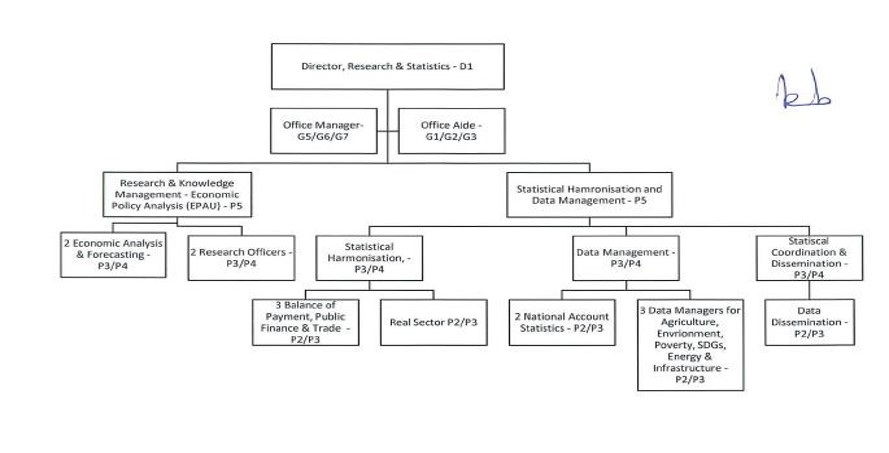
• Impact: This activity provides a roadmap for National Statistical Institutes to measure climate impacts, ensuring ECOWAS agricultural and environmental safety policies are based on real-time ecological data. 5. Tracking Progress via Digital Platforms The Directorate trains technical focal points on the African Regional Integration Synthesized Index (ASRII) Digital Platform. • Impact: This tool measures integration progress across four pillars: political, economic, infrastructural, and human/social integration. It explicitly evaluates how well regional programs are working to realize the African Union’s Agenda 2063 Organogram
|
Discover how ECOWAS is transforming communities, economies and the lives of West African citizens — one story at a time.