Initializing...
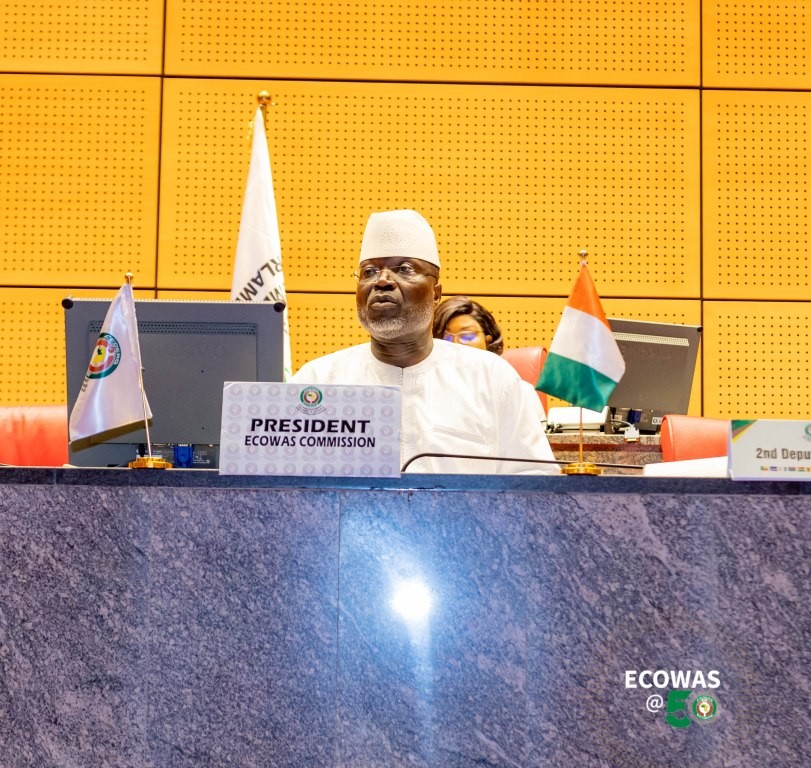
The President of the ECOWAS Commission, H.E. Dr. Oumar Alieu Touray, presented the 2025 Annual Report on the State of the Community to the ECOWAS Parliament during the Second Ordinary Session of the Sixth Legislature, presided over by the Speaker, H.E. Mrs. Maimounatou Ibrahima, at the ECOWAS Parliament in Abuja, on the 5th December 2025.
The presentation offered a comprehensive review of regional developments and institutional performance across key sectors in a year of profound significance, as ECOWAS celebrates 50 years of regional integration, solidarity and collective progress.
President Touray reaffirmed the Commission’s commitment to transparency, accountability and collaborative governance, noting that the 2025 report reflects both major achievements and unprecedented challenges. The withdrawal of three founding Member States, Burkina Faso, Mali and Niger, was highlighted as one of the most consequential developments of the year, with far-reaching political, economic and security implications.
Despite these challenges, President Touray underscored notable progress across the region. He reported improvements in economic growth, declining inflation, strengthened regional security operations, enhanced trade integration and major strides in sectoral development. ECOWAS, he emphasized, has continued to reinforce diplomatic engagement and institutional resilience to safeguard regional stability and uphold the principles of cooperation and unity.
According to the report, global economic trends in 2025 were characterised by moderate growth, declining inflation and stabilising commodity prices. African economies, including those within ECOWAS, demonstrated resilience despite insecurity, debt burdens and structural weaknesses. Within the region, economic performance improved, with growth projected to reach 5.0% in 2026. Inflation fell sharply from 24.4% in 2024 to 16.8% in 2025, supported by stronger revenue mobilisation and sustained macroeconomic reforms.
The report also documents significant progress in peace and security, driven by strengthened preventive diplomacy, mediation initiatives and electoral support. ECOWAS deepened cooperation with the African Union, United Nations and other international partners to address shared security threats.
Key security achievements in 2025 include the deployment of the regional Standby Force, expansion of the West African Police Information System (WAPIS), and joint maritime patrols to combat piracy and transnational crime. ECOWAS institutions, including the Parliament, Court of Justice, GIABA and WAHO, continued to promote democracy, credible elections, rule of law, anti-financial crime efforts and public health protection.
In the area of regional integration, ECOWAS made strong advancements by strengthening the Customs Union, implementing trade facilitation measures, promoting private-sector growth, advancing women’s economic empowerment and expanding youth entrepreneurship. Steady progress was also recorded in the roadmap toward the ECO single currency.
Sectoral achievements included continued investment in regional power and renewable energy projects, harmonisation of regional codes, development of strategic transport corridors, expansion of digital infrastructure, including roaming frameworks and submarine cable connectivity, improved food security, increased climate resilience and ongoing implementation of ECOWAP. Progress was also achieved in gender equality, education, youth development, humanitarian response and public health, even as the ECOWAS Bank for Investment and Development (EBID) faced financial pressure linked to Member State withdrawals.
President Touray outlined strategic recommendations aimed at strengthening regional resilience and accelerating integration. These include enhancing counter-terrorism coordination, advancing free movement initiatives such as ECOVISA and SIGMAT, increasing investment in agriculture and renewable energy, boosting climate adaptation, reinforcing domestic revenue mobilisation, harmonising public finance frameworks and supporting Member States undergoing political transitions.
Reaffirming the Commission’s long-term commitment under Vision 2050: “ECOWAS of the People: Peace and Prosperity for All”, President Touray emphasized the organisation’s dedication to deepening regional solidarity, advancing inclusive development and safeguarding peace and stability across West Africa.
Discover how ECOWAS is transforming communities, economies and the lives of West African citizens — one story at a time.