Initializing...
THE ECOWAS CENTRE FOR GENDER DEVELOPMENT (CCDG) HOSTS THE SPANISH AGENCY FOR INTERNATIONAL DEVELOPMENT CO-OPERATION (AECID) FOR A TECHNICAL WORKING VISIT AS PART OF THEIR PARTNERSHIP ON GENDER ISSUES IN WEST AFRICA
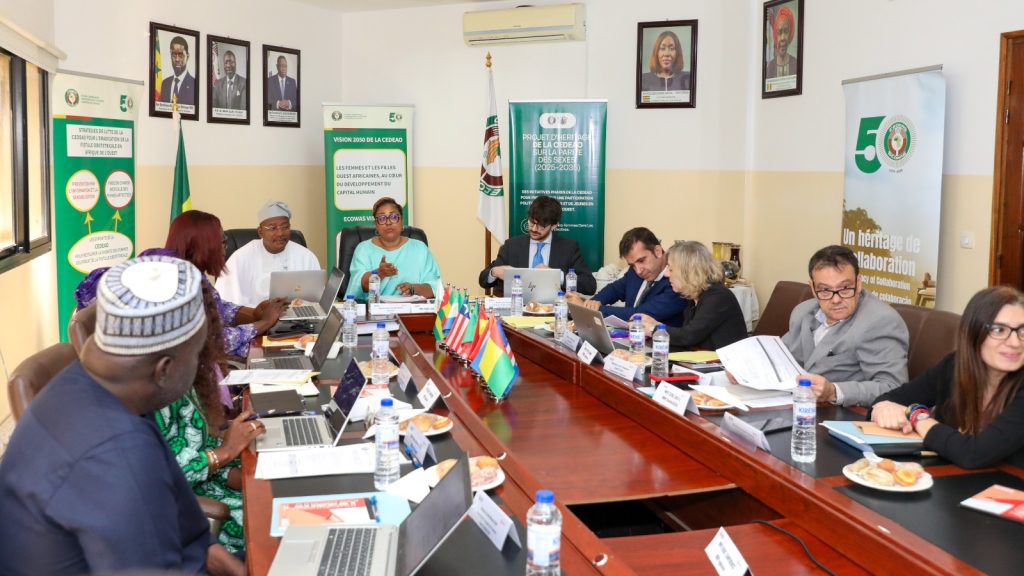
The ECOWAS Centre for Gender Development (CCDG) hosted the Spanish Agency for International Cooperation and Development (AECID) at its headquarters in Dakar, Senegal from 27 to 28 April 2026, for a technical working visit as part of their partnership on gender-related issues in ECOWAS member states. The aim of this technical working visit was to strengthen joint monitoring and technical coordination between the CCDG and the AECID in order to ensure the harmonised and effective implementation of the activities planned as part of their collaboration and also to review the progress made and the challenges faced by this partnership, which began in 2024; to approve the work plans for 2026; to identify any potential constraints; and to jointly develop appropriate solutions for future initiatives.
The visit was attended by the Director of External Relations at the ECOWAS Commission and staff from the CCDG. The AECID delegation comprised: Mr Lucas FERNÁNDEZ, Regional Cooperation Officer for Sub-Saharan Africa, Mr Santiago ORMEÑO GARCÍA, General Coordinator of the Spanish Cooperation Office in Nigeria and ECOWAS; Ms Lara FERGUSON VÁZQUEZ DE PARGA, Head of the Gender Unit; Mr Juan Arroyo, Programme Manager, AECID Senegal; Ms Ruth García, Country Officer for Senegal, AECID.
In her welcome address, Ms Sandra OULATÉ FATTOH, Director of the CCDG, emphasised that this technical working visit represents a crucial opportunity to strengthen joint monitoring and technical coordination between the CCDG and the AECID in order to ensure the harmonised and effective implementation of activities; it also serves to create the conditions for the successful ownership of the results achieved through their collaboration. She therefore believes it remains necessary to strengthen their partnership, which has a proven impact on communities. She concluded by emphasising the need to “above all, mobilise and work more closely together to address the challenges relating to gender equality and women’s empowerment, through the involvement and participation of all stakeholders, in order to build an egalitarian region characterised by peace and justice”.
The Director of External Relations, Mr Jerôme BOA, congratulated the Director of the CCDG and her staff on their strong commitment, which has brought the agency back into the spotlight and raised its profile through initiatives that have been well received by the various beneficiaries. He also welcomed the high-level delegation from AECID. He noted that his participation in this technical working visit demonstrated the value of the collaboration between ECOWAS and AECID, and that there is a need to further develop and monitor this collaboration so that it yields decisive results in improving the living conditions of the people of West Africa.“I encourage you to continue to make the most of this partnership, whose activities contribute significantly to improving the living conditions of people in the region and to achieving ECOWAS’s development objectives in its Member States,” he concluded.
Mr Lucas FERNÁNDEZ, Regional Cooperation Officer for Sub-Saharan Africa, noted that over the past three years, the ECOWAS/AECID partnership had delivered significant results, demonstrating its strength and relevance. He emphasised that the Institutional Support project, which was designed in full alignment with the objectives of the CCDG’s strategic plan, contributes to the achievement of AECID’s development objectives in West Africa, where gender equality is identified as a priority for action. The CCDG is therefore a key partner for AECID in its efforts to support ECOWAS in realising its ambition of a fully integrated region where women, on an equal footing with men,benefit equally from opportunities for economic and social development; and that they are genuinely involved in all stages of public development policy-making: from conception and decision-making through to implementation. He concluded by stating: “The two-day technical workshop provides a valuable opportunity to take stock of the progress made and to jointly set priorities for the coming years.”
This technical working visit enabled the CCDG and the AECID to identify joint priority actions to be carried out over the next two years, as well as to agree on a methodology to ensure optimal coordination, regular monitoring and strategic alignment in their implementation.
The technical working visit also included meetings and site visits with beneficiaries including the Women’s Reception and Reintegration Support Centre for the Treatment of Obstetric Fistula (MARFO) and implementing partners, the Ministry of Family, Social Action and Solidarity; the Ministry of Health and Public Hygiene of the AECID’s Fistula Care Support Project. The discussions highlighted the importance of fully utilising, within the framework of this project, the expertise of Senegalese medical and paramedical staff specialising in the management of obstetric fistula. To this end, skills transfer and capacity-building workshops for healthcare professionals from other beneficiary Member States and the ECOWAS region are essential priority measures for implementation.
As a reminder, the collaboration between the CCDG and the AECID takes place within the framework of the partnership agreement between the ECOWAS Commission and the AECID in areas of mutual interest, including gender.
Discover how ECOWAS is transforming communities, economies and the lives of West African citizens — one story at a time.