Initializing...
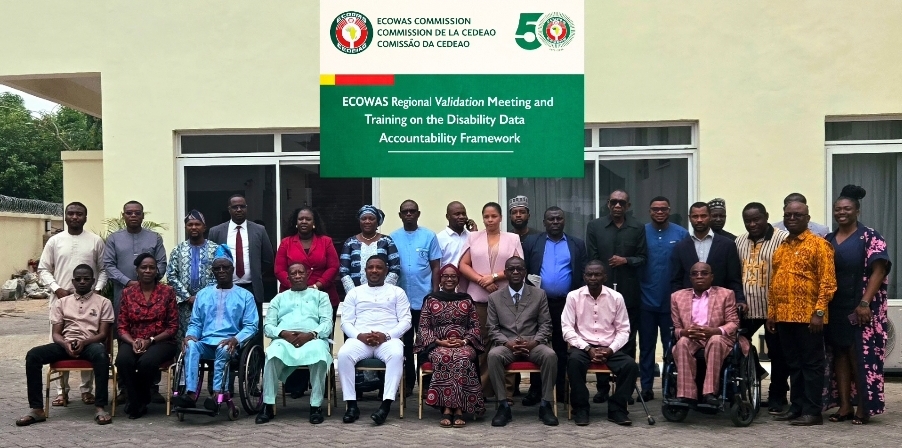
The ECOWAS Commission is advancing a decisive regional agenda to strengthen disability inclusion across West Africa by leading the validation of a Disability Data Accountability Framework aimed at improving the collection, harmonisation and use of disability-disaggregated data, enabling Member States to move towards more coordinated, evidence-based and accountable policymaking. Convened on 14 April 2026 in Abuja, Nigeria, the Regional Experts Validation Meeting brought together representatives of ECOWAS Member States, national institutions, technical experts and partners in a hybrid format, allowing both in-person and virtual participation, including the African Union Commission and UNICEF.
At the centre of the discussions was a critical regional reality: without reliable and comparable data, persons with disabilities remain largely invisible in national development planning, with direct implications for policy design, resource allocation and inclusive development outcomes.
Speaking on behalf of the President of the ECOWAS Commission, H.E. Dr. Omar Alieu Touray, and the Commissioner for Human Development and Social Affairs, Prof. Fatou Sow Sarr, Dr. Alves D’ALMADA JORGE, Principal Programme Officer, Social Affairs, Directorate of Humanitarian and Social Affairs of the ECOWAS Commission, underscored that the initiative builds on a 2021 regional diagnostic study which revealed structural gaps, inconsistencies and outdated disability data across Member States.
“Without reliable and harmonised data, persons with disabilities remain largely invisible in national development planning,” he stated.
He emphasised that these shortcomings continue to undermine inclusive policymaking, weaken monitoring systems and limit effective resource allocation, noting that the framework under validation is intended to serve as a common regional reference to strengthen data systems, improve comparability and reinforce accountability across the region.
Chairing the meeting, Mr. John CONTEH, Acting Director of Social Welfare, Ministry of Social Welfare of Sierra Leone, described the framework as a strategic tool to operationalise the ECOWAS Disability Action Plan 2020 to 2030 and ensure that commitments to inclusion are translated into measurable and practical results.
Participating virtually, Dr. Olubusayo AKINOLA, Head of the Social Welfare, Drug Control and Crime Prevention Division at the African Union Commission, emphasised the importance of aligning the framework with Agenda 2063 and key human rights instruments, noting that robust data systems are central to advancing accountability and inclusion across Africa.
From a social policy perspective, Ms. Adebisi ARIJE, Social Policy Specialist at UNICEF, highlighted that millions of children with disabilities remain uncounted in national statistics, limiting their access to essential services and protection. She reaffirmed that inclusion begins with visibility in data and stressed UNICEF’s continued support to Member States through technical assistance and statistical systems strengthening.
Development partners also reaffirmed their commitment. Following the opening address delivered on behalf of the Executive Secretary of the National Commission for Persons with Disabilities of Nigeria, Mr. Peter EKEMINI, Diversity Advisor and Focal Person for the Physical and Mental Abilities Dimension at the Gender, Diversity and Inclusion Secretariat, GIZ Nigeria, took the floor and commended the ECOWAS Commission for its leadership.
“Disability inclusion is a core feature of our work. We remain committed to ensuring that persons with disabilities fully enjoy their rights, with the removal of barriers that hinder their full and effective participation in society,” he stated.
He further highlighted ongoing efforts to strengthen institutional capacity through data-driven approaches, including diversity audits, accessibility assessments and the integration of inclusion markers into development programming.
With these priorities clearly established, discussions moved into a more focused working phase under the guidance of Ms. Abimbola OYELOHUNNU, Programme Officer, Social Affairs, Directorate of Humanitarian and Social Affairs of the ECOWAS Commission.
“For too long, we have been working with assumptions rather than facts,” she noted, calling for harmonised, consistent and actionable data systems capable of informing national planning and regional decision-making.
The meeting also brought together national leadership, including Dr. Ayuba GUFWAN, Executive Secretary of the National Commission for Persons with Disabilities of Nigeria, reinforcing the importance of national ownership in implementing regional commitments.
Over the course of the validation process, experts are reviewing and refining the framework to ensure that it meets international standards while remaining adaptable to national contexts.
Through this initiative, the ECOWAS Commission is reinforcing its leadership in promoting inclusive development, advancing a transition from advocacy to evidence and from commitment to implementation, while laying the foundation for more accountable, data-driven and inclusive governance across West Africa.
Discover how ECOWAS is transforming communities, economies and the lives of West African citizens — one story at a time.