Initializing...
Dakar, 12 October 2026 — More than one hundred participants representing Member States of the Economic Community of West African States (ECOWAS), civil society organizations, and regional institutions met online on Monday, 12 October 2026, to contribute to the development of a common regional position on the care economy, climate action, and the green economy.
Organized by the ECOWAS Commission, through its Gender Development Centre, in partnership with UN Women, and chaired by Senegal, which currently holds the rotating Chairmanship of the ECOWAS Authority of Heads of State and Government, the consultation forms part of the preparations for the 71st session of the Commission on the Status of Women (CSW71), launched under the auspices of the African Union. Scheduled to take place in March 2027 in New York, CSW71 will focus on accelerating progress towards gender equality by 2030. In this context, the consultation sought to align the priorities of ECOWAS Member States around two key issues: investing in care systems and advancing women’s participation in the transition to a green economy, with a view to informing the African Common Position.
Opening the meeting on behalf of Senegal’s Minister of Family, Social Action and Solidarity, Mr. Adama Baye Racine Ndiaye, Secretary-General of the Ministry, identified five priority areas: investment in care systems; climate action and the green transition; decent work opportunities for women in the green economy; strengthened data and accountability mechanisms; and enhanced regional leadership. He stressed the need to translate commitments to gender equality into concrete public policy priorities.
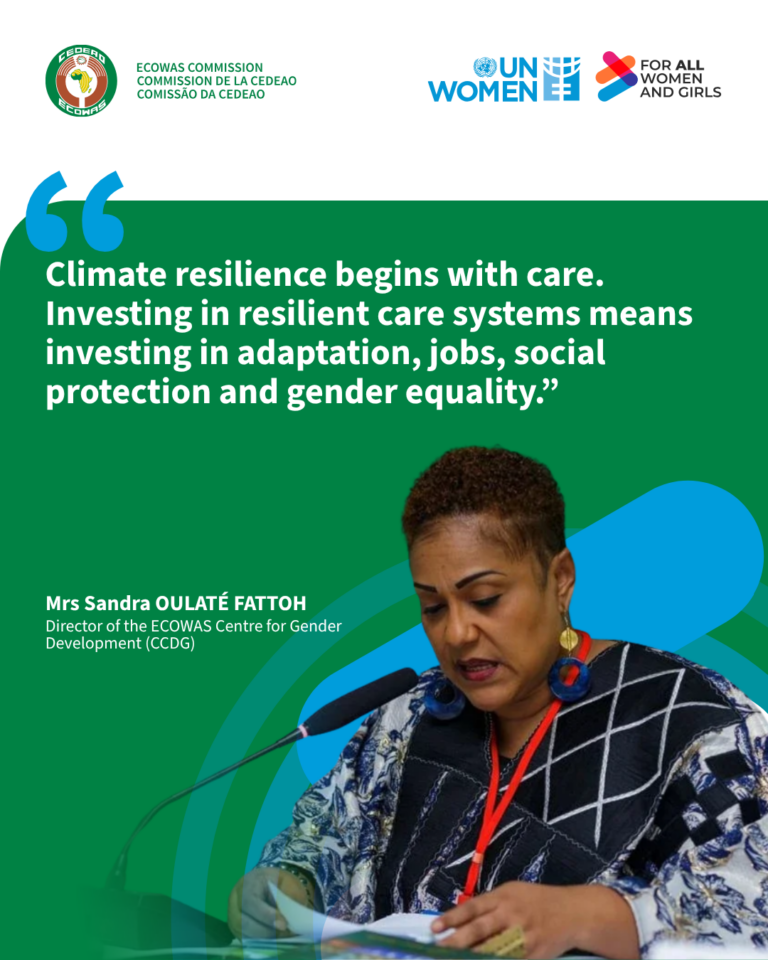
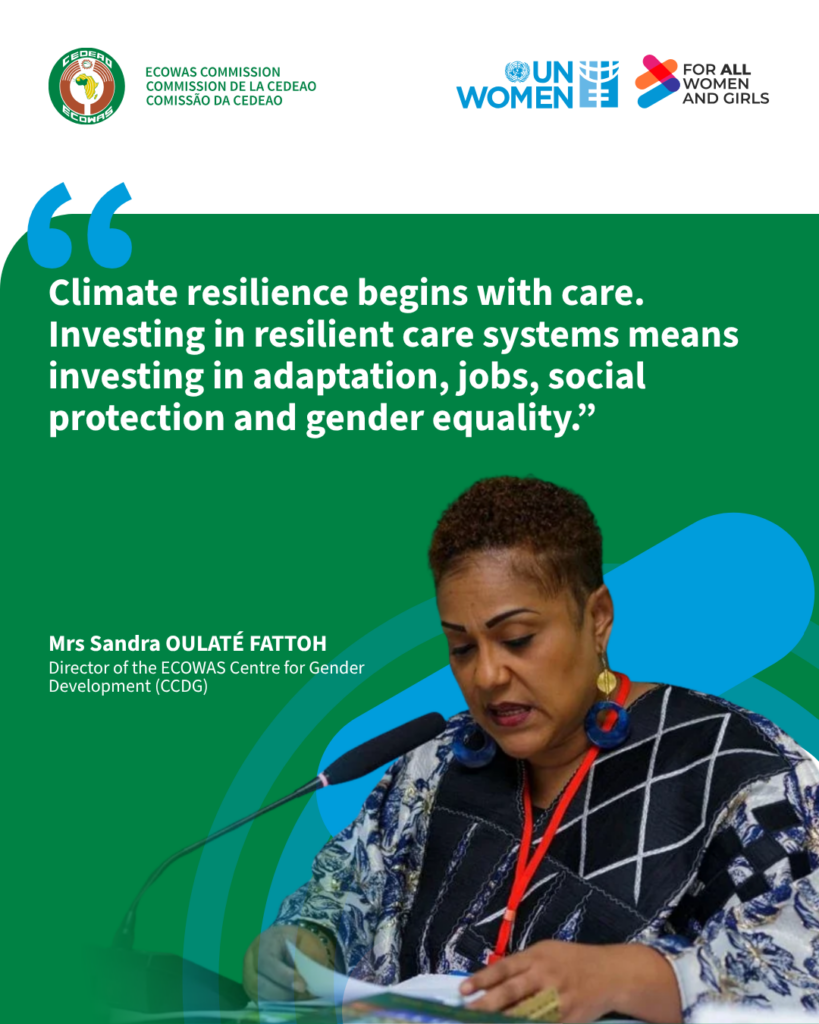
Ms. Sandra Oulaté Fattoh, Director of the ECOWAS Gender Development Centre, underscored that achieving the Sustainable Development Goals requires greater attention to both the care economy and climate action, two closely interconnected issues. “Climate resilience begins with care,” she stated.
For Dr. Maxime Houinato, UN Women Regional Director for West and Central Africa, “this consultation demonstrates what we can achieve when we work together around a shared vision.” He called on the region to speak with “a coherent, forward-looking voice” that reflects both its challenges and its solutions.
ECOWAS Sets a Common Course Ahead of the 71st Session of the Commission on the Status of Women
Discussions focused on two regional initiatives presented and championed by ECOWAS. The first, dedicated to the care economy, is based on a mapping of care systems across the ECOWAS region carried out with the support of UN Women. The study highlights the disproportionate burden of unpaid care work borne by women and the potential of investments in care to generate jobs, promote gender equality, and foster inclusive growth. It identifies seven regional priorities, including governance, data production, national policy frameworks, professionalization of care occupations, and financing. The experience of Cabo Verde, which has had a national care plan in place since 2017, was highlighted as a promising example. The second initiative focuses on gender-responsive climate action and the green economy.
Developed by ECOWAS specialized agencies with technical support from UN Women, the regional programme aims to strengthen women’s participation and leadership in the green transition, particularly through access to green jobs, climate finance, and entrepreneurship opportunities in agriculture, renewable energy, water management, and the circular economy. A Common Declaration to Carry the Region’s Voice from Addis Ababa to New York The interactive dialogue enabled Member States and civil society organizations to enrich the regional priorities under discussion. Participants emphasized the importance of recognizing women as agents of solutions, better reflecting the realities of rural women, and increasing investments in education, including positive masculinity, early childhood development, and the transformation of social norms.
They also stressed the need to ensure that the green transition becomes a genuine source of economic opportunities for women. At the close of the consultation, Senegal presented the joint declaration adopted by participants. ECOWAS’s contribution will be consolidated by the end of the week and presented at the African Union meeting on 28–29 October in Addis Ababa, where it will help shape the African Common Position ahead of CSW71. The position will subsequently be submitted for adoption by ministers responsible for gender equality on the margins of the Commission’s session in New York in March 2027.
Discover how ECOWAS is transforming communities, economies and the lives of West African citizens — one story at a time.