Initializing...
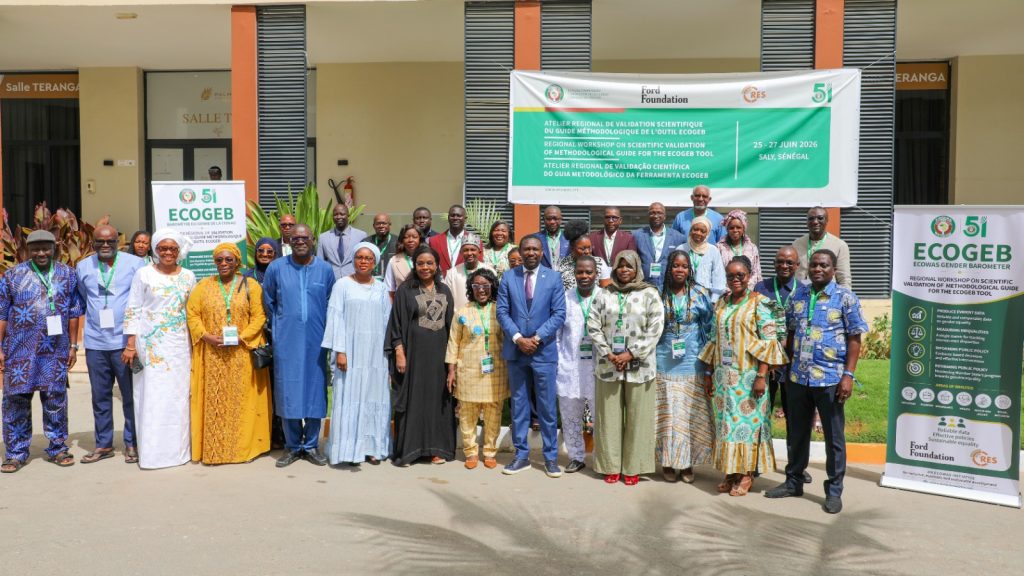
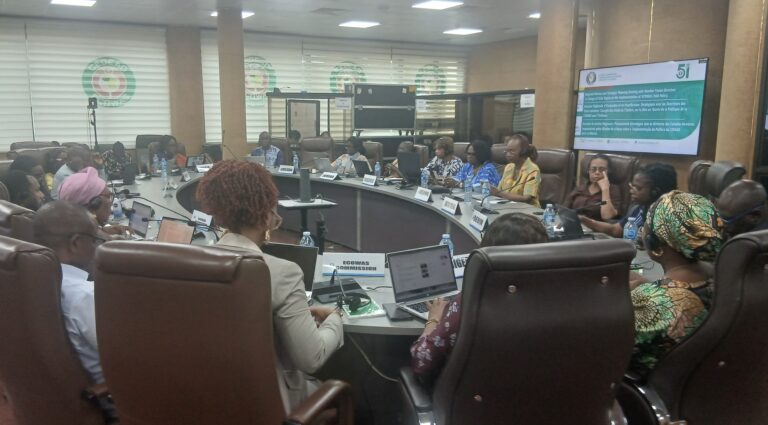
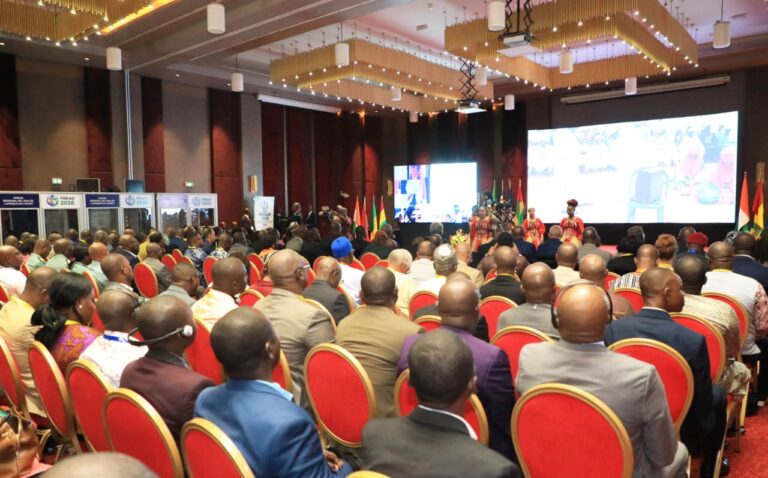
From 25 to 27 June 2026, the ECOWAS Centre for Gender Development (CCDG) brought together representatives of national statistics offices, research centres, regional institutions, and technical and financial partners in Saly Portudal, Senegal, for the Regional Scientific Validation Workshop of the ECOWAS Gender Barometer (ECOGEB) Methodological Guide.
The opening ceremony was chaired by Hon. Professor Fatou Sow Sarr, Commissioner for Human Development and Social Affairs, in the presence of Dr. Kalilou Sylla, Commissioner for Economic Affairs and Agriculture, H.E. Zelma Yollande Nobre Fassinou, ECOWAS Resident Representative in Senegal, Professor Abdoulaye Diagne, Executive Director of the Consortium for Economic and Social Research (CRES), and a representative of the Ford Foundation.
The ECOGEB is a regional initiative launched by ECOWAS to provide the Community with a harmonized tool for measuring and monitoring inequalities between women and men. Since 2023, the work carried out has led to the establishment of a database, the development of a regional gender equality index, and the strengthening of evidence-based data to inform public policies and monitor progress in Member States.
Speakers highlighted the importance of ECOGEB in filling gaps, particularly in the availability of quality data that is regularly collected, analyzed, and used in decision-making processes—an essential condition for building truly inclusive economic and social policies.
In her welcome remarks, H.E. Zelma Nobre Fassinou, ECOWAS Resident Representative in Senegal, emphasized that ECOGEB reflects ECOWAS’ commitment to achieving a historic ambition: deep socio-economic integration and political governance that serves all, in line with ECOWAS Vision 2050. She stressed that effective policies cannot exist without reliable data, nor informed decisions without quality statistics, and that genuine equality requires rigorous measurement of progress and remaining challenges.
The representative of the Ford Foundation, Mr. Omar N’Diaye, noted that data is essential because without it, efforts risk being blind, dispersed, and difficult to measure in terms of impact. He thanked Professor Fatou Sow Sarr for championing the vision of establishing a database to support countries in combating gender-based violence and promoting gender equality, and reaffirmed the Ford Foundation’s commitment as a strategic partner until the initiative is fully achieved.
Professor Abdoulaye Diagne, Executive Director of CRES, recalled that ECOGEB is a strategic instrument that provides policymakers, planners, activists, and decision-makers in the region with a navigation tool based on rigorous, comparable, updated facts—anchored for the first time in West African realities.
In his address, Dr. Kalilou Sylla, Commissioner for Economic Affairs and Agriculture, stressed that one of the major reasons for the marginalization of women’s contributions to ECOWAS economies, and the inequalities they face in wealth distribution, is the lack of concrete data to assess their real contribution to economic dynamism. He underlined that systematically integrating gender into statistical systems is not optional but a strategic necessity to build more competitive, resilient, and equitable economies. He called on researchers, data producers, and users to strengthen investments in the production, analysis, and use of gender data.
In her opening speech, Hon. Professor Fatou Sow Sarr reminded participants that a region that guarantees equal opportunities sustainably improves the well-being of its populations, and ECOGEB must help accelerate this transformation. ECOGEB data, she said, are a strategic lever of governance, enabling decisions to be informed, results to be evaluated, accountability to be reinforced, and resources to be invested where they have the greatest impact. Ultimately, ECOGEB should contribute to strengthening regional political dialogue and supporting advocacy efforts to reduce gender inequalities across Member States. She concluded by reaffirming that “gender equality is not only a matter of social justice. It is also an economic imperative, a driver of growth, stability, and resilience.”
During the workshop, representatives of national statistics offices, research centres, and partners discussed and made recommendations on the choice of dimensions and indicators, methods of weighting and aggregating data, and frameworks for collaboration with stakeholders on data collection and use.
The draft ECOGEB Methodological Guide thus marks an important step in the process of consolidating and institutionalizing the tool within ECOWAS’ statistical data collection and analysis system.
Discover how ECOWAS is transforming communities, economies and the lives of West African citizens — one story at a time.