Initializing...
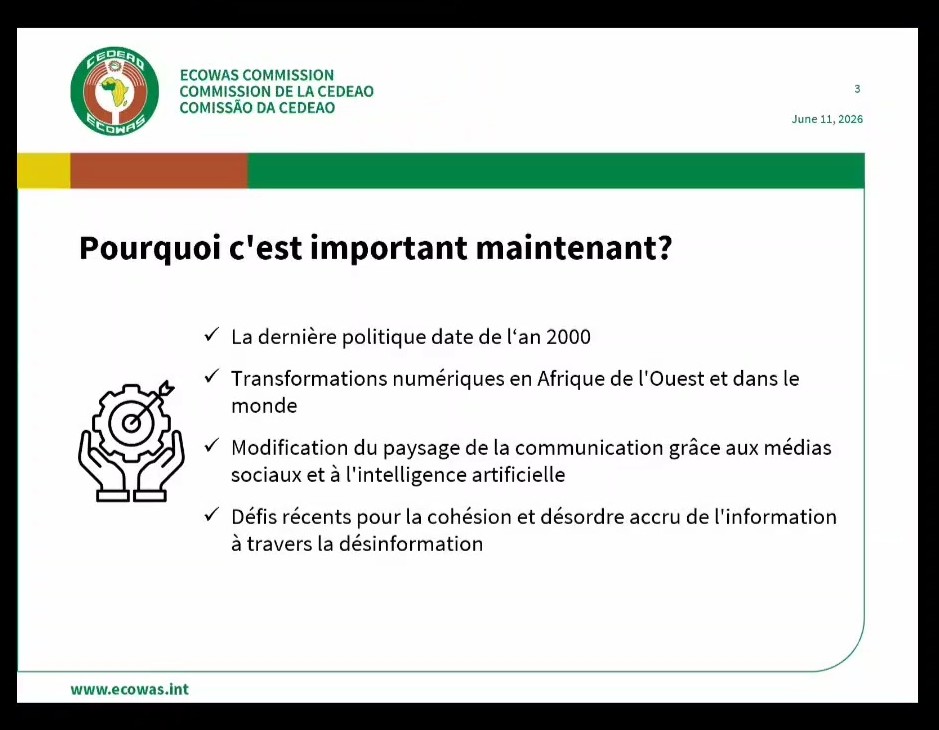
The Directorate of Communication of the Economic Community of West African States (ECOWAS) convened a virtual information and planning meeting on 11th June 2026, for ECOWAS Directors and Representatives to present the newly developed ECOWAS Communication Policy 2026 and Communication Strategy 2026–2030.
Opening the meeting, the Director of Communication, Mr. Joel AHOFODJI, welcomed participants and highlighted the importance of the new communication framework in addressing emerging challenges such as digital transformation, misinformation and disinformation, declining public trust, and the need for greater regional cohesion through a unified ECOWAS voice.
During the presentation, participants were briefed on the Communication Policy 2026, which establishes a common institutional framework for standardized communication across ECOWAS institutions. The policy defines communication roles and responsibilities, strengthens internal and external communication practices, introduces crisis communication guidelines, addresses information disorders and disinformation, promotes knowledge management, and supports capacity building for staff. It also seeks to enhance the reputation, credibility, and integrity of ECOWAS while ensuring greater coordination among institutions.
The meeting further examined the ECOWAS Communication Strategy 2026–2030, which aims to align communication efforts across the Community in support of the ECOWAS Vision 2050. The strategy focuses on increasing public awareness of ECOWAS mandates and achievements, strengthening stakeholder trust and engagement, improving institutional visibility, and promoting a “One ECOWAS” approach through coordinated, people-centred communication. Particular emphasis was placed on digital storytelling, youth engagement, traditional media outreach, public diplomacy, and the use of human-interest stories to demonstrate the impact of ECOWAS programmes on citizens.
An interactive discussion followed the presentation, during which Directors and Representatives exchanged views on implementation modalities, communication coordination mechanisms, institutional responsibilities, and the integration of communication planning into programme delivery. Participants underscored the growing importance of communication as a strategic management tool that contributes directly to policy implementation, programme effectiveness, and citizen engagement.
The meeting concluded with a training session on Strategic Communication and Effective Media Engagement for Senior Leadership, designed to strengthen the capacity of Directors and ECOWAS Representatives for future media interactions. The session provided practical guidance on interview preparation, message discipline, crisis communication, handling difficult questions, and maintaining institutional credibility. The Directorate of Communication reaffirmed its commitment to supporting all ECOWAS institutions through strategic communication guidance, media relations support, and capacity-building initiatives as the Community moves toward the implementation of the new Communication Policy and Strategy.
Découvrez comment la CEDEAO transforme les communautés, les économies et la vie des citoyens d'Afrique de l'Ouest — à travers chaque histoire.